






"Put Out The Cigar!"
January 12, 2026
It is the year 2008. I have about a week ago, had my school year conclude. As it always is with students, I am chuffed that the 8 months-long educational program has been paused, for the next three months.
However, unlike my age-mates, I don’t get to spend my entire vacation just watching and playing football. That’s because, I, with my mom’s insistence, help out my teacher at my Quranic school. “Kabiir” is what Somalis call what I do, a lieutenant of sorts to the teacher.
Whilst in this routine, one of my maternal uncles, Mogadisho-based, visits us in Garowe. This is his first time leaving Mogadisho and arriving in Puntland. His goal is to get to know his relatives, and take the opportunity to meet his father, my maternal grandfather, who is with us at the time. I have heard of this uncle before, but this is my first time meeting him. The chemistry is good and we manage to jell right away.
In one of our get-togethers, he starts talking about what Mogadisho, a city he dearly loves, is like. “It’s much more than the mere bad news and eternal conflict you hear about,” he tells me. “It’s a mega city, and despite its difficult present, full of life, and potential,” he adds. He kept on singing Mogadisho’s praises, and near the end of our conversation, right before we would leave for the Maghreb prayer, suggested that I return with him and spend my next school year in Mogadisho.
Even though I was hesitant to give a definitive answer, curiosity got the better of me, and I appeared somewhat open to the idea. “Even if I wanted to, there is no way mom’s response to this suggestion will be nothing but an outright rejection,” I remark. “Leave that part to me,” he retorts.
No clue how he did it, but he managed to convince mom, and she approved of my departure, and our trip. I am nervous, but also, a bit excited.
The trip, to be travelled by land, commenced. It was a long journey, passing through a third of all of Somalia’s 18 provinces, namely: Nugal, Mudug, Galgadud, Hiran, Middle Shabelle, ending with Banadir.
We would conduct it in two halves: a) from Garowe to Beledweyne, and b) Beledweyne to Mogadisho.
The first half of it wasn’t too bad. The road being terrible aside, an issue that will persist throughout, we didn’t encounter too many problems. Having a nice lunch in Adado, Galgadud’s soil being quite reddish, and too many Guinea fowls lining either side of the road, is all I can recall from that part of the trip.
We then arrived in Beledweyne, where we would rest for three days before resuming the rest of our ride, warmly hosted by a friend of uncle’s, in what would turn out to be the highlight of my trip. I don’t know what it was about Beledweyne, but it altogether had a soothing feel about it.
The weather felt incredibly moderate, the food: epic. Its people were teeming with warmth, and everything just seemed to perfectly fall into place. It was the most at home I felt since leaving home.
I would visit and tread on the town’s famous “Liiqliiqato” bridge, the very bridge on which the late Somali poet, Hadrawi, met the gorgeous Beerlula, and was smitten right away. This encounter, encompassing their one-time meeting at her home, where he, in awe of her beauty, froze and could utter no words, to their second meeting that never was because his retinue had to leave earlier than was planned, is what would lead to him penning the lyrics of the iconic Beledweyne song, sang by the celebrated Somali vocalist, Hassan Aden Samatar. It must have been drought season because the river had no water flowing through it that day, and was dry.
With reluctance, it was time to leave Beledweyne for Mogadisho, and we hit the road. Most of this half of the trip was to be conducted at night. That was because majority of the area ahead was controlled by the now powerful al-Shabab terror group, who, having recently splintered off from the Islamic Courts Union, were somewhat still nascent at the time. Minimizing possible contact with al-Shabab militants was a priority for all drivers and their passengers, and for good reason.
In Bal’ad in Middle Shabelle, I still clearly remember the details of an encounter with an al-Shabab militant near the town’s checkpoint.
As the norm is with trips that long, our driver had classic Somali songs (Qaraami) playing. Not only that, but he was also profusely smoking throughout, another trait common among long-distance drivers. Ordinarily, drivers would be careful when nearing al-Shabab controlled crossings, but this militant appeared out of nowhere, and stopped our car before it had reached the routine checkpoint.
I can vividly recall the look of horror on everyone’s face and how petrified we all were. That was because this armed militant, a teenager (teenagers tend to be erratic, irrational), had both heard the song playing in the car, and saw the driver hurriedly trying to put out his cigar. All the passengers were in unison yelling at the driver to quickly “switch the music off and put out the damn cigar!”
The al-Shabab militant ordered all the men onboard to alight and would frisk us all. He would scathingly admonish the driver, threatening him that he would inform his fellow militants ahead to keep an eye out for an “immoral, deeply irreligious driver on the road.”
When this horror show ended and we had gotten back inside the vehicle, we all sighed in relief, urging the driver to quit both the music and smoking for the remainder of the trip, and not lead us all to doom. This encounter, the shock of it all, in many ways signalled what was to come.
At long last, we arrived in Mogadisho. Ethiopian soldiers stationed at the city’s checkpoint ordered that we disembark, and searched the car. Visibly armed to the teeth, each one of the soldiers even had mini-axes on them.
Still reeling from the fierce recent battles between the then-TFG (Transitional Federal Government) soldiers, backed by Ethiopian troops, and the Islamic Courts Union militants, how militarized the city was immediately captured my attention.
Seldom could one move for a few minutes without seeing armed men brandishing their guns, walking past porous walls pockmarked by bullets, hearing the deafening sound of mortar shells, or feeling the overwhelmingly foreboding sense that something bad is about to happen in this scarred city.
Right around that time, Amisom peace-keeping troops, separate from the Ethiopian troops and made up of majority Ugandans, were in their droves flowing to Mogadisho. Their arrival was particularly problematic for the residents of the city, because these AU-mandated troops were quite heavy-handed in their approach, and would disproportionately respond to any minor attack that came their way.
For instance, in one of my first nights in the city, some al-Shabab fighters fired few rounds of bullets at a Ugandan troops’ base evening-time. Their response: the indiscriminate and directionless firing of mortar shells and other heavy artillery from 8:00 p.m. that night all the way through to around 7:00 a.m. the following morning.
This type of sustained shelling being new to me, I couldn’t get myself to sleep, and hence stayed up all night. It was such an uncomfortable experience; a harbinger of what was to follow.
In those days, security was bad in Mogadisho to the extent where it was a common practice that husbands would, before heading to work, leave their wives with “parting words,” Dardaaran, in the event they don’t safely make it back home. This would entail what loans to pay, who to call for money, and what to do with the kids. My uncle too would do this, and it was a constant reminder of how unsafe the city was.
There was more than one thing one could die from; be it an al-Shabab assassination, a stray Amisom mortar shell, or an argument-gone-wrong with a TFG soldier. (TFG soldiers were notorious for engaging in acts of banditry and robbing people of their valuable possessions.)
Explosions too, an al-Shabab trademark, were a near-daily occurrence. I recall this time when a huge explosion, the result of a landmine planted in a nearby road going off, rattled all the homes in the neighbourhood, including ours. To date, that remains the loudest sound I've heard.
In a separate incident, while washing some of my clothes, fragments of a mortar shell fell on the courtyard of our house. I was incredibly lucky, as some landed within touching distance.
My stay—spanning over three months—wasn’t however, all grim.
I formed a great friendship with my English teacher, who went by the moniker “Booroow,” a warm, easy-going personality; the type of teacher whose jokes would instantly brighten up the mood in a tense classroom. I would love to know what has become of him.
I came to a city overflowing with cheap fruits. If you had about three thousand Somali shillings, it would buy you three to four bananas. (I am told in present-day Mogadisho, that has long not been the case.)
My Somali accent, thick and too formal, would often put me in comic situations, giving away what region I was from. This would manifest itself in different ways, the simplest of which was, for example, when answering the door, where I would ask “Yaa weeye?” instead of the lighter, less formal “Yaa waaye?” used in Mogadisho.
One morning, while bringing back vegetables I bought for the house, a dog, my first time seeing one live, started barking at me, and that turned into a chase game which went on for a good few minutes.
I was still in the city when the TFG President, the late Abdullahi Yusuf, resigned, following a bitter political feud with his late Prime Minister, Nur Adde, and then Speaker of Parliament.
His resignation and subsequent departure from Mogadisho coincided with my own imminent departure, and through acquaintances, we were presented with the option of boarding his plane, headed to Puntland.
But since Abdullahi was a much-loathed figure in Mogadisho, there was always the risk of his plane being targeted, and the family opted otherwise.
I ended up boarding Daalo airline’s civilian plane, having not completed the whole school year, but only a term of the two. The plane itself was antique, and its passenger stairs, of shoddy build and feeling wobbly as one scaled them, were separately wheeled to and not built into the plane.
In early January of 2009, I arrived in Galkayo, marking the end of a little over three months’ stay in the Somali capital.
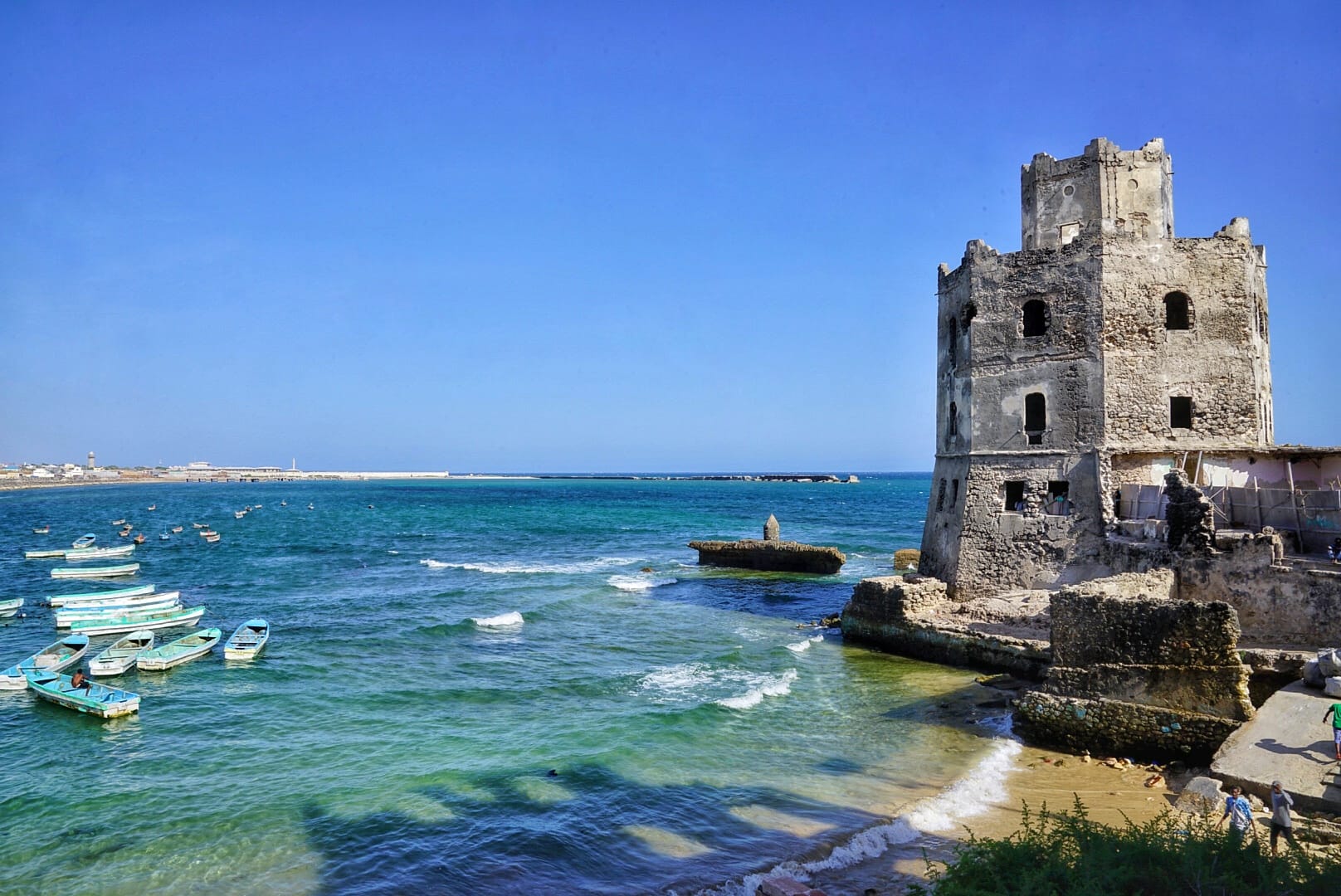
My personal memories of Mogadisho, mostly of travails and negative experiences, reflected one of the city’s most difficult chapters. I returned to it a decade later in 2018, and the wholesale change in every aspect was amazing to see.
It was still imperfect, as explosions would occasionally go off, and assassinations still rife. But it was a marked change from the active war zone—largely controlled by al-Shabab—that I lived in a decade earlier. There were no daily explosions, half a day of heavy shelling, and random projectile fragments flying overhead.
In this new-look Mogadisho, one could enjoy moments of respite, of not looking over their shoulder, and needed not to be on edge all the time. Security was much-improved, resulting in a thriving city.
That was then, in 2018. Though I haven’t visited it since, by all accounts, the security situation is even better now. Furthermore, seeing the city recently host local elections of democratic nature with no security incidents reported, however flawed and controversy-ridden the overall process might have been, was a sight to behold.
When the people of Mogadisho pronounce their city safe, I believe them, because their point of reference, I recognize, is wartime Mogadisho; like the one I briefly stayed in in 2008, or perhaps for some, the even worse period of the 1990s.
Related post
© All Right Reserved - The 1943 Magazine
