






Book Review—Warriors: Life And Death Among The Somalis—Part 2

January 20, 2026
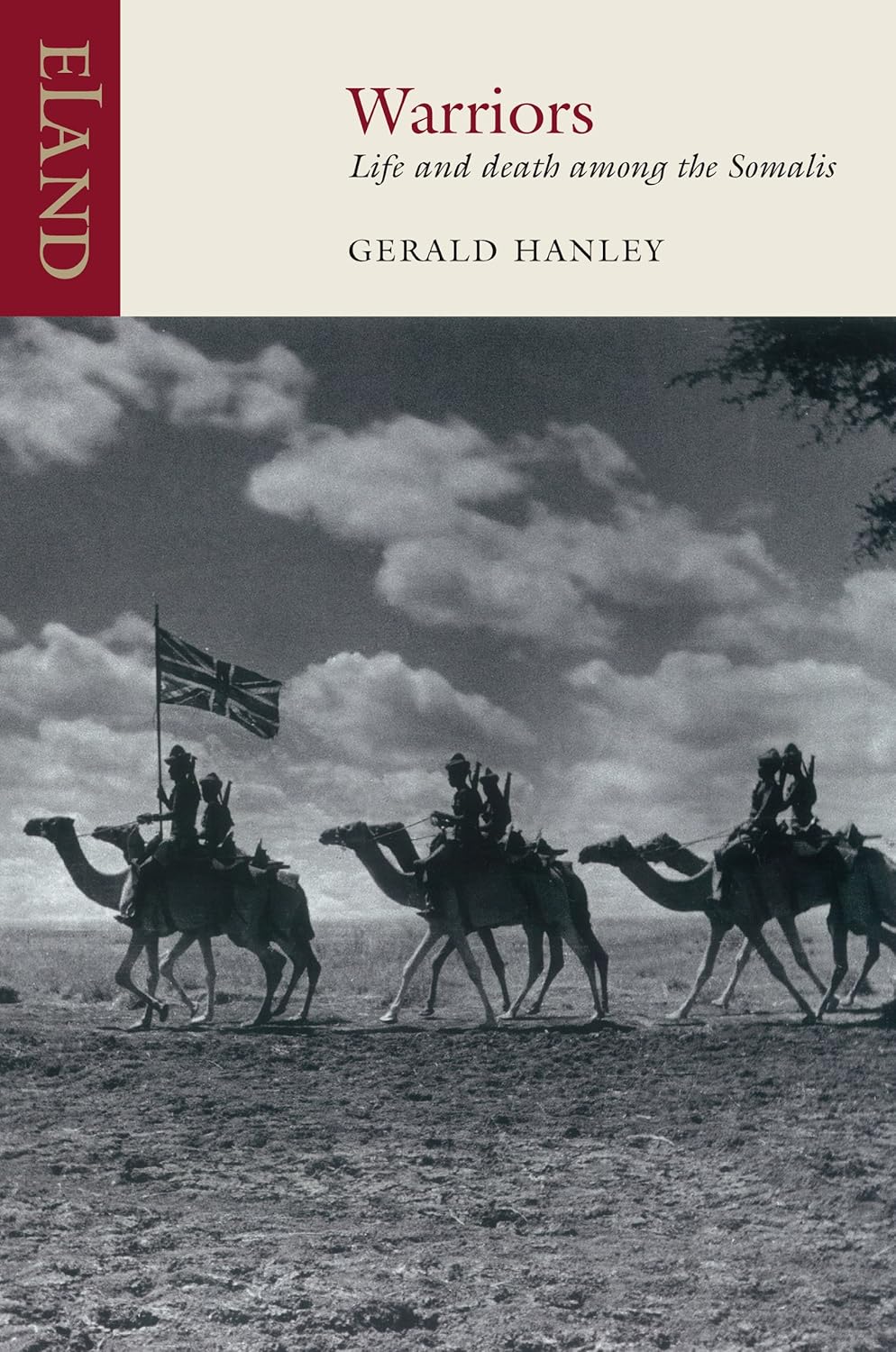
To read Warriors contrapuntally is to recognize that Hanley’s descriptions are not neutral nor fair. They emerge from a specific historical and intellectual milieu—the British imperial worldview in its twilight. While he recoils at the casual racism of his fellow officers, he does not entirely escape the colonial gaze himself. Indeed, while most of the time he portrays his fellow whites sardonically, he at the same time demonstrates a lack of self-awareness. His depiction of Somali fatalism, for instance, is worth interrogating:
“I never saw a Somali who showed any fear of death, which, impressive though it sounds, carries within it the chill of pitilessness and ferocity as well.”
This reads as admiration—an acknowledgment of Somali courage and resilience. Yet, its framing is distinctly colonial. The link between courage and “pitilessness” echoes the trope of the noble yet ruthless native. By framing fearlessness as ferocity, he intimately dehumanizes Somalis, casting them as warriors rather than multifaceted individuals. This reduction reinforces the imperial narrative of an untameable people.
Similarly, Hanley’s reflections on Somali hospitality is delivered through a lens of suspicion.
“Of all the races in Africa, there cannot be one better to live among than the most difficult, the proudest, the bravest, the vainest, the most merciless, the friendliest, the Somalis.”
Hanley’s paradoxical portrayal—Somalis as both the “friendliest” and the “most merciless”—reinforces the colonial trope of the unpredictable native. Is this contradiction real, or does it reveal the imperial writer’s struggle to reconcile admiration with the need to depict the colonized as inherently different?
This is the paradox of the book, Warriors: Hanley is an astute and often poetic observer, but his perspective is not outside history. Like many before him, he writes from the position of a colonial officer trying to make sense of a people who defy imperial narratives of control and subjugation.
Throughout Warriors, Somalis oscillate between admiration and condescension. At times, Hanley marvels at Somali resilience, their fearlessness, and their unwavering independence. Yet, beneath these praises lies a subtle but persistent framework that positions Somalis as fundamentally different from, and implicitly inferior to, Europeans. Hanley’s portrayal aligns with a long-standing colonial literary tradition, in which the native is exalted for traits that ultimately reinforces their exclusion from civilization and modernity.
Hanley repeatedly emphasizes Somali confrontation, often in ways that appear admiring but ultimately serve to cast them as ungovernable and locked in a primitive state. He writes:
“A Somali always felt himself to be twice as good as any white man, or any other kind of man at all, and still does, even when he is wrong.”
The phrase “even when he is wrong” suggests more than mere stubbornness—it conveys an unshakable conviction, a disobedience that resists correction or compromise. The emphasis on “even” reinforces the idea that, for the Somali, being right is secondary to being resolute. This mirrors colonial anxieties about the so-called “flatter-noses-than-ourselves creatures,” whose unwavering self-assurance frustrates imperial authority. Yet, is this truly an indictment of Somali obstinacy, or a reflection of the colonial writer’s frustration with a people who refuse to be governed on his terms?
Like many colonial writers, Hanley falls into the pattern of taking care to “civilize” these savages. He writes:
“I had no desire to civilize these wild nomads, and told them so quite often.”
Like Prospero dismissing Caliban as an uncivilizable brute— “A devil, a born devil, on whose nature / Nurture can never stick”—Gerald takes the paternalistic tone of “la mission civilizatrice,” “the civilizing mission.”
Yet, this refusal is not an act of respect but of exclusion, affirming an inherent, unbridgeable difference. Just as Prospero’s rejection of Caliban justifies his domination of the island, so too does Hanley’s indifference serve to reinforce colonial superiority—Somalis, like Caliban, are beyond salvation, destined to exist outside the bounds of “civilization.”
Even when Hanley acknowledges Somali intelligence, it is hedged with a certain skepticism:
“…but it is not their fault that they are ignorant. Their natural intelligence is second to none and when the education factories start work among them, they should surprise Africa, and themselves.”
On the surface, he acknowledges Somali intelligence, but frames their “ignorance” as an inherent condition—one that is not their fault but still exists. The phrase “education factories” reduces learning to a mechanized process, suggesting that only Western-style schooling can unlock their potential. The implication is clear: Somalis, despite their intelligence, remain unformed until shaped by colonial education. The final remark— “they should surprise Africa, and themselves”—reflects an external gaze, one that assumes Somalis do not yet recognize their own capabilities, reinforcing the colonial myth of the enlightened outsider akin to I know you more than you know yourself, sort of.
It is a common colonial strategy—acknowledge the native’s mental capacity but frame it as something alien, unstructured, or instinctual rather than rational.
It is unbelievably amazing how this echoes Prospero’s begrudging acknowledgment of Caliban’s linguistic ability, while ultimately dismissing him as incapable of true refinement:
“You taught me language, and my profit on't / Is, I know how to curse.” (The Tempest, Act1, Scene 2.)
Hanley frequently describes Somalis in hyper-masculine terms—fierce warriors, unbending, fatalistic. While this might seem like praise, it reduces them to a single dimension, stripping them of emotional depth and complexity. He does not dwell on Somali family life, governance structures, or intellectual traditions. Instead, he presents them primarily as fighters, much like Conrad’s portrayal of the Africans in Heart of Darkness—as drummers in the distance, warriors in the shadows, never as fully developed characters.
In contrast, European figures in Hanley’s text are allowed complexity. The British officers are not merely warriors—they reflect, they struggle with moral dilemmas, they experience doubt. This subtle differentiation reinforces the colonial hierarchy: the European is fully human, the Somali is trapped in a singular, static identity.
This kind of prose exposes, thanks to Edward Said, one notorious imperial formula: outward admiration that ultimately reinforces exclusion. By praising their fearlessness, he casts them as outside the structures of governance. By marvelling at their fatalism, he denies them historical agency. In acknowledging their intelligence by calling it “unexpected,” he frames it as something alien. This rhetorical strategy is crucial to understanding colonial literature. It allows the writer to claim objectivity—to say, “I admire these people”—while still positioning them as fundamentally different and outside the reach of modern civilization. It is the same strategy Shakespeare uses with Caliban, the same one Conrad too employs with his nameless, faceless natives.
The “we-versus-us” discourse, notorious in colonial texts with all of its genres, features heavily in this book as well.
To engage critically with Hanley’s Warriors: Life and Death Among the Somalis is not to outright dismiss his observations, nor is it to deny that his writing captures something compelling about Somali resilience. However, to only pick out his admiration (what triggered this review), while ignoring the deeper undercurrents of condescension and exclusion, would be, as my literary criticism godfather Edward Said called it, an act of intellectual cop-out. It would be to take his words at face value, to assume that praise in a colonial text is unproblematic, and to overlook the ways in which admiration can serve as a rhetorical tool for reinforcing hierarchy. And that truly strikes me as sheeplike behavior.
True critical engagement demands that we see both what Hanley says and what his words conceal. It behooves us to recognize how his portrayal—however evocative—still operates within the colonial framework that has long cast the “native” as either the noble savage or the ungovernable subject. To ignore this, to selectively only take the flattering parts of his account while disregarding its underlying logic, is not thoughtful reading. It is naiveté.
The task then becomes not rejecting Hanley’s work wholesale but reading it with the scrutiny it warrants. His work, like The Tempest and Heart of Darkness, or any other colonial text for that matter, is most useful when it is interrogated rather than passively received. To read him contrapuntally is to strip away the veneer of admiration and reveal the structures of thought that shaped his perspective. Anything less would be an uncritical embrace of a colonial gaze masquerading as objectivity.
I wrap this up by saying: to accept praise from someone who concurrently insults you poetically is nothing short of foolishness. I choose not to be a fool.
Related post
© All Right Reserved - The 1943 Magazine
